
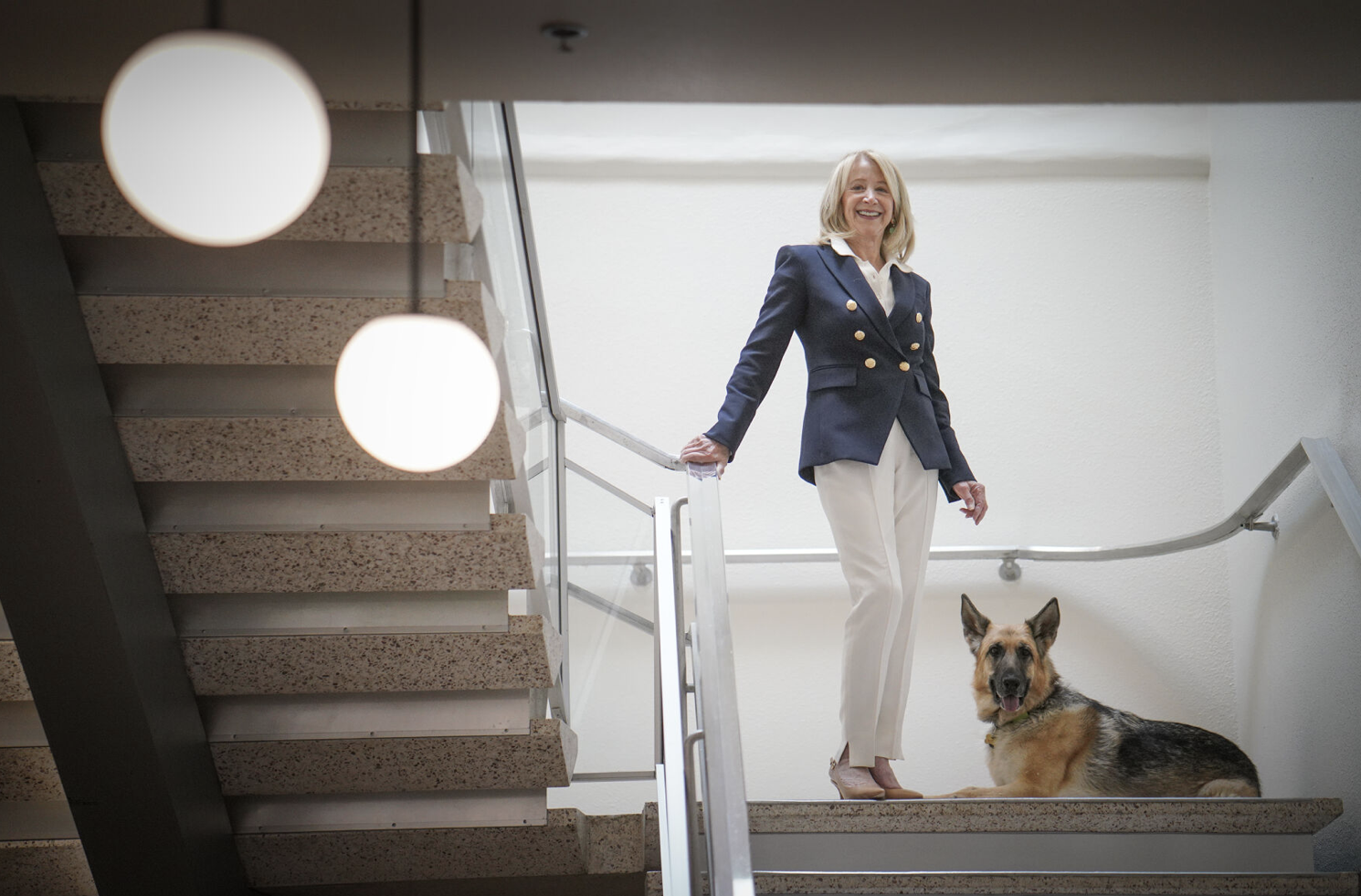
Beth Beloff, founder and CEO of nonprofit New Mexico Climate Investment Center, is pictured Monday with the nonprofit’s mascot, Duchess, in a stairway of the organization’s new home at the New Mexico Innovation Hub on the midtown campus.
By Mike Easterling measterling@sfnewmexican.com
May 18, 2026
A nonprofit that provides financing to spur the use of technologies that reduce greenhouse gas emissions and other pollutants has become the latest tenant to join the lineup at the New Mexico Innovation Hub.
Hub officials announced in a Thursday news release that the New Mexico Climate Investment Center, which works with both residential and commercial customers, has moved into the hub’s home in Benildus Hall, 1055 Midtown Calle Central in the Aspect Media Village mixed-use development on Santa Fe’s midtown campus.
According to the hub’s founder and CEO, David Perez, the climate investment center will occupy a little more than 1,000 square feet on the first floor of Benildus Hall. The organization will join several other high-tech tenants at the hub, including the New Mexico Consortium, Woodruff Engineering, New Mexico Angels, the New Collar Network and the New Mexico Fusion Igniter.
Perez said the center is a valuable addition to the types of entities that already exist there.
“The New Mexico Climate Investment Center is an important part of our startup ecosystem, providing financing where other institutions do not,” he said.
Beth Beloff, the CEO of the center, said her organization moved into its new home in midtown at the beginning of May, relocating from its former location at 150 Washington Ave. downtown.
“We’re in one of the music practice spaces, so it feels very much like we’re back in school,” Beloff said, chuckling while referencing Benildus Hall’s history as the onetime home of the music department at the College of Santa Fe.
That doesn’t mean her organization’s move to a new home has been awkward, she said.
“It’s just wonderful,” she said. “It’s a good fit for us. The whole innovation ecosystem is a good fit for us. … We’ve found kindred spirits in that building.”
Short history, rapid impact
Beloff said she worked for years to get the climate investment center off the ground, finally succeeding with seating the organization’s board and earning nonprofit status in spring 2024.
The center opened for business on Jan. 1, 2025, buoyed by a $10 million legislative appropriation the previous year and approximately $1 million in foundation grants Beloff had secured.
The center has had a significant impact in a short amount of time, she said, noting it has mobilized $30 million in capital in a year and a half and has a pipeline for approximately $90 million.
“We are new, but we have been extremely fortunate in filling some of the financing gaps for borrowers who meet our criteria,” Beloff said.
Among the projects the organization has helped fund is one mounted by Backyard Farms in Las Cruces, which launched an initiative to help address food insecurity in underserved areas and ease the economic hardships of medium-size farm operations. With the financial assistance provided by the center, Backyard Farms officials built a freeze-drying operation that processes bruised or overripe produce from small farms, creating dehydrated produce that otherwise would have gone to waste, been sent to a landfill and produced methane gas upon rotting.
“Their products have been incorporated into statewide food programs,” Beloff said. “We gave them a bridge loan to fill a financing gap and carry them over until some of their grants and other funding came through. That’s one of the projects we are quite pleased about.”
A second project involves financing the center provided to Bidii Baby Foods in San Juan County, she said. The Navajo company received financing to purchase a tract of land adjacent to the Navajo Nation that it needed to grow the produce it uses in its products.
Beloff said Bidii Baby Foods was a good partner for the climate investment center because the company employs regenerative agricultural practices that leave more carbon in the soil. The company also has a strong Navajo customer base, minimizing shipping distance and thereby lessening its carbon footprint, she said.
The center also has provided financing for a project in which low-income housing units received energy-efficiency retrofits, decreasing their energy use and lowering utility costs for residents. And it plans to provide financing for a solar array to power a water authority and is developing a project to create a solar array to power a complex of adobe buildings.
But the organization has been challenged in its early stages by a lack of awareness of its existence. Beloff said she has battled that by doing everything she can to increase the organization’s visibility at conferences and workshops and on social media. The center also partners with other organizations pulling in the same direction.
Beloff also has made some staffing changes to address the issue.
“We just hired a marketing consultant that started last week, and we have a development consultant who is building our channels and exposure,” she said.
She said she doesn’t think it will be long before the center’s work is well known among those who need its services.
“Given the interest we’re getting from partners, we feel like we’re filling a financing gap that heretofore has gone unfilled,” she said.
More tenants in the pipeline
The climate investment center won’t be the last addition to the innovation hub. Perez said he hopes to announce the signing of a few more tenants in the weeks ahead, explaining he is in the final stages of working out agreements with those entities.
At that point, the hub will be at capacity, he said.
“It is very gratifying and rewarding to see how much demand there is in the market,” he said, adding that in just five months since the facility opened, all of its available space will have been taken if those additional tenants come on board as expected.
Perez said he is designing a new 5-acre live/work development at midtown that will serve as an expansion of the hub. That project would include 120,000 square feet of office and lab space along with 60 residential units. Work on the 75,000 square feet of lab buildings is scheduled to get underway early next year, he said.
Perez said the speed at which the innovation hub has filled up has surprised him in one respect, although he added he always had faith the project would be a success.
“What’s also rewarding is seeing the response from everyone in the community,” he said. “We pursued this in a way that responds to what the needs were in our community. People talked, and I listened.”
Perez credited Phillip Gesue, the developer behind Aspect Media Village, for pivoting away from a focus on TV and film production facilities, as he originally envisioned, toward high-tech entities.
“That’s how this has all come together,” Perez said.
This story has been amended to reflect the following corrections. A previous version of this story incorrectly stated the New Mexico Climate Investment Center had mobilized nearly $90 million in capital. The organization has mobilized $30 million in capital and has a pipeline for approximately $90 million.
The story also incorrectly stated the center had provided financing for a solar array for a complex of adobe buildings for a water authority. The center will provide financing for a solar array to power a water authority and is developing a project to create a solar array to power a complex of adobe buildings.
In a photo caption, founder and CEO Beth Beloff incorrectly was identified as the executive director of the center.