
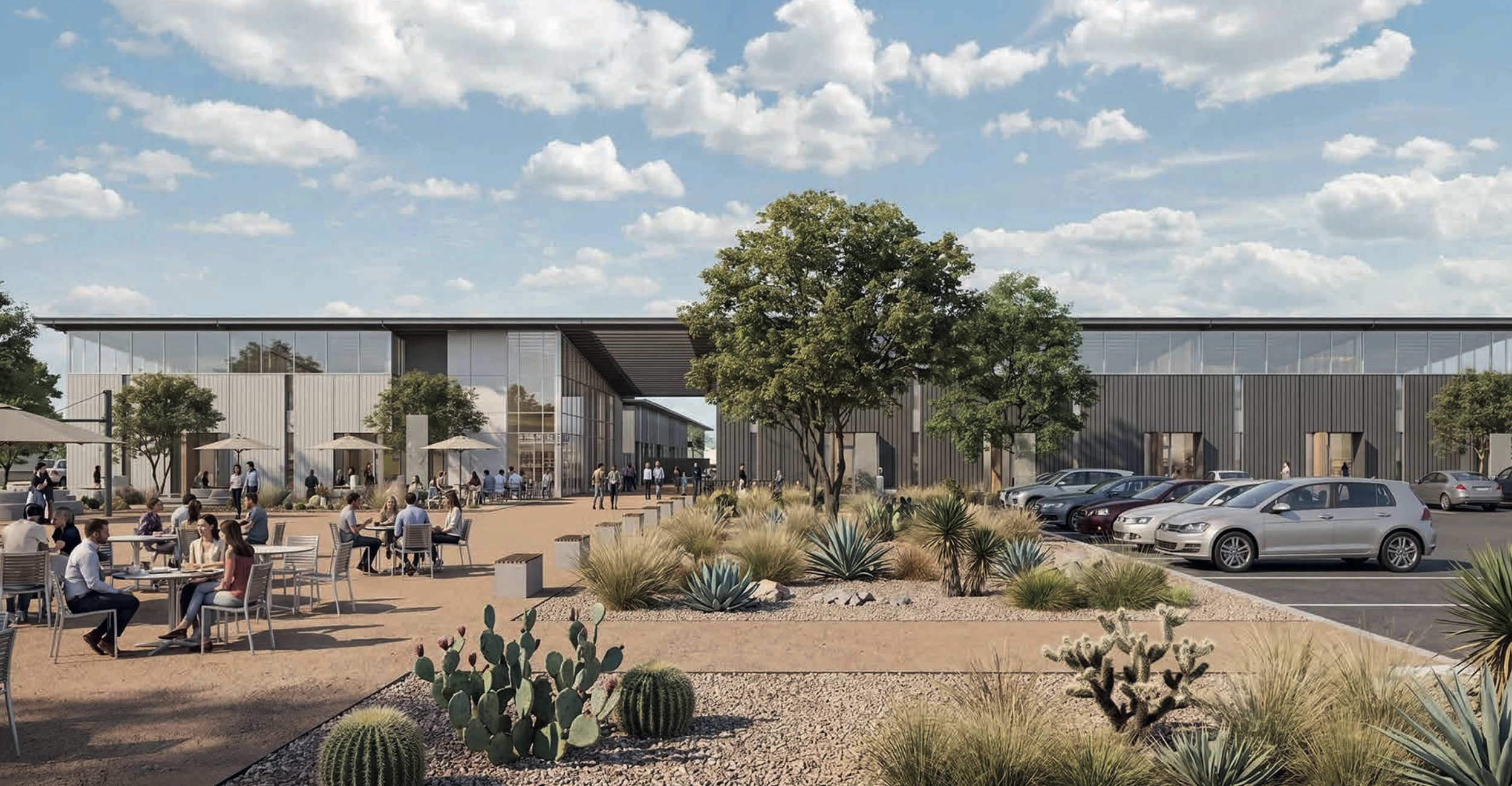
Rendering of the New Mexico Innovation Hub; Above: Benildus Hall, where the NMIH is currently based
Filling Empty Buildings with the Future
By Seth Roffman
Green Fire Times • November/December 2026 • Pages 15–17
In February 2026, Santa Fe’s emerging Midtown District got a major boost from the New Mexico Economic Development Department’s (NMEDD) Technology and Innovation Office, which awarded the city a $700,000 grant to develop a state-of-the-art innovation campus. The award was part of the state’s inaugural Innovation Infrastructure Grants, a program designed to expand the physical spaces startups and researchers need to grow and stay in New Mexico. The awardees were selected through a competitive evaluation process based on their expected contributions to economic growth and diversification, as well as their alignment with one or more of the division’s priority sectors.
“How do we use the substantial assets this state has to grow and diversify our economy so we are less dependent on oil and gas, especially as New Mexico moves toward carbon-free electricity by 2045?” asked David Perez, founder/CEO of the New Mexico Innovation Hub (NMIH). “Turn tech-transfer into companies.” NMEDD’s investment supported renovation of the former Santa Fe University of Art and Design’s 32,000-square-foot Benildus Hall, which is anchoring the NMIH. The Hub has fast become a center of gravity for the local innovation economy to support startups, drive technological advancements and accelerate economic development. “This investment reflects what we’re seeing on the ground in Santa Fe,” said Johanna Nelson, director of the City of Santa Fe Office of Economic Development. “There is growing demand for space where ideas can turn into businesses, talent can connect to opportunity, and innovation can take root locally.”
NMIH’s campus, including space in other Aspect Media Village buildings, is providing essential infrastructure and supportive programming to help local companies thrive, while also attracting talent and innovative companies from across the country and around the world. “Santa Fe is a unique, deeply cultured place and that is already a global destination,” Perez said. “We want to use all of those assets to attract entrepreneurs and technologists to build their companies here, and to build their lives here too.”
Since January, more than 70,000 square feet of previously vacant buildings, an old gymnasium and an old tennis club—all within a two-minute walk of each other—has been leased to 11 organizations, and the Hub hosted events for the city, universities, national labs, nonprofits and industry associations. Perez says these results prove there is demand from local companies that are seeking to be part of a community, not just rent space.
That community is taking shape at the NMIH. Prometheon Power is developing localized geovoltaic power. Liberty Fusion is commercializing fusion technology born at Los Alamos National Laboratory (LANL). Bandelier Technologies, a quantum-sensing startup, began operations after raising more than $2 million. Slazer AI is bringing LANL algorithms to real-estate valuation. In May, the New Mexico Climate Investment Center relocated its headquarters to the NMIH. Other enterprises include Woodruff Engineering, New Mexico Fusion Igniter, New Mexico Angels, and the New Mexico Consortium, a nonprofit formed by the University of New Mexico, New Mexico State University and New Mexico Tech to facilitate research and increase interaction between universities, industry and LANL.
Local people will benefit. The New Collar Network Fab Lab is training the next generation of technicians and makers for high-paying jobs without requiring a college degree. Santa Fe Community College’s nonprofit, Mosaica, is working with the Hub to bring an advanced machining lab and related programs to campus, connecting students with startups and employers. Mosaica will occupy nearly 4,800 square feet, with two full-time employees and two adjunct faculty members. About 25 students will initially be enrolled in courses.
For Santa Fe, the Hub means vacant buildings are productive again. It also means that technology developed at the national labs can become companies headquartered there, and that founders like Bandelier’s Stephen Buchanan, who moved his young family from the East Coast, are choosing Santa Fe as home. For the business community, it means a growing network of customers, partners, talent and investors in one place.
Expansion Planned
NMIH’s Phase 2 expansion has secured financing from the New Mexico Finance Authority through its Enterprise Commercial Development Fund. The project is expected to begin construction early in 2027 and open in mid-2028. Companies are asking to hold space before the buildings even exist. Pre-leasing has begun for four structures, constituting approximately 85,000 square feet of flex, lab and maker spaces. Flex spaces can blend office, storage and industrial usage in a single, adaptable unit.
Fusion supply-chain companies need more than an office: 22-foot ceilings, mezzanines and layouts will be built to suit each tenant, and ample three-phase power will be provided. Roughly 10 MW of power will serve NMIH’s campus. Perez expects to have space for up to 10 tenants. Some will be tech startups in the advanced energy, quantum or manufacturing sectors, but the developer has also been in talks with a gym and a physician’s practice. A 50,000-square-foot office building is expected to open in late 2029, along with a café run by a local restaurant. Multifamily apartments are also planned.
Perez told The Albuquerque Journal that the land acquisition and development are “honestly secondary” and more of a byproduct of the community NMIH is building. “We are creating an ecosystem where scientists, academics, students, entrepreneurs, investors and state agencies gather. This community on the same 5-acre campus will generate economic momentum. In addition, we are working with the state to obtain funding to build labs with equipment to be shared by members on campus, instrumentation that no single startup could justify on its own.”
“We are 36 miles south of Los Alamos and 40 miles north of Sandia,” Perez said, “so we are a natural meeting point for people from both labs, and both are interested in leasing space and working closely with the companies here. Los Alamos in particular is the anchor that makes the whole ecosystem work, the magnet that draws students, industry and companies that want to be close to the science. The talent concentrated at the labs, and at University of New Mexico and New Mexico Tech, is the raw material for everything we are building.”
“Just as important,” he added, “the Hub is an unclassified, entrepreneurial environment, so private industry can meet openly with lab employees and students. The Feynman Center for Innovation, the office that helps Los Alamos commercialize its technology, is a sponsor of the Hub, and we work closely with them through programs like their Lab Embedded Entrepreneur Program. One of those companies, Bandelier Technologies, is already a tenant here, and our job is to help companies like that grow and stay in New Mexico.”
Kelly Stanhope, NMIH’s operations director, said, “For anyone building something in Santa Fe, or wanting to support those who are, the Hub’s doors are open. The Hub has a limited number of desks available in our co-working space—putting you right in the middle of one of Santa Fe’s most exciting and growing innovation communities.” For availability, details and rates, email KELLY@NM-IH.COM. For more information on the NMIH, visit NEWMEXICOINNOVATIONHUB.COM.